Introduction
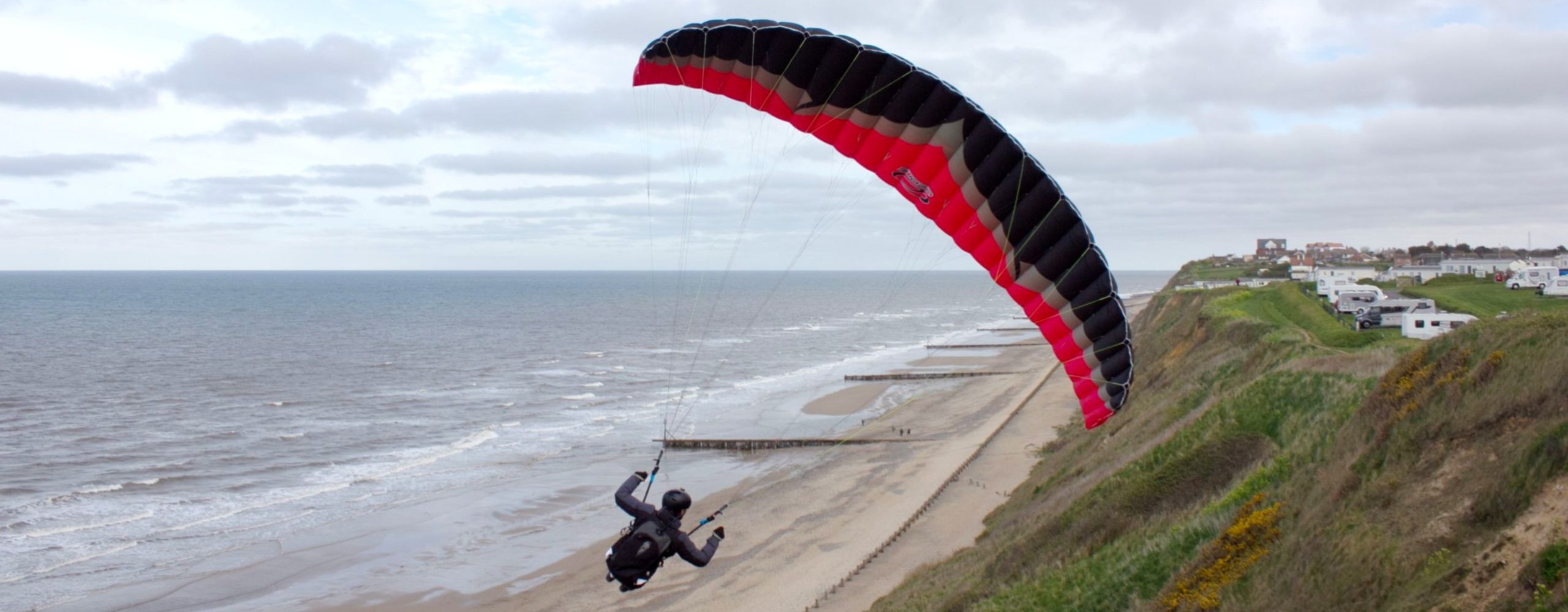
Have you ever watched a pilot effortlessly cruise back and forth along a coastal cliff, flying for hours or simply hanging in the air? It looks like magic, but it’s just physics. This is soaring, and it’s an extremely fun way to fly and get lots of time under your wing.
The Science of Ridge Lift
At its core, ridge lift is simple. When a steady wind (laminar flow) hits a large obstacle like a ridge, a cliff, or a steep hill, the air has nowhere to go but up. This creates a band of rising air on the windward face of the ridge.
This is the “lift” we fly in. To stay airborne, we just need to follow one simple equation:
The rising air must be moving upwards faster than your wing is naturally sinking downwards.
Every wing has a natural “sink rate”—the speed it descends in still air. For a high-performance paraglider, this might be a gentle 1 m/s. For a speedwing, built for speed and dive, the sink rate is much higher (e.g., 4–5 m/s or more).
This is the key challenge for us: because speedwings sink faster, we need stronger wind and more powerful lift to soar. Where a paraglider might float in a 10–11 knots breeze, a speedwing pilot often needs 13–17+ knots winds to generate enough upward force to overcome their wing’s natural desire to descend.
From Physics to Flight
Okay, so now you understand the physics. The goal is to keep your wing in that rising band of air. But turning that theory into a safe, repeatable skill on a fast-moving wing is where the real challenge begins.
Master High-Wind Groundhandling (Non-Negotiable)
Before you even think about standing on a cliff edge in a 15-knot wind, you need to be the undisputed boss of your wing on the ground.
Start on a flat, open field and gradually practice in stronger and stronger winds. You need to be comfortable kiting, controlling surges, and killing the wing instantly. The rule is simple and absolute:
If you can’t confidently ground handle your wing in the current conditions, you have absolutely no business trying to fly in them.
Part of this skillset includes knowing how to safely collapse your wing in high winds. One effective method is learning to pull on the B risers to deflate the wing quickly and bring it down without it dragging you. Important: this technique is only to be used on the ground—never attempt to pull the B risers mid-flight, as it will cause your wing to collapse. This is essential because it helps you avoid being dragged into a dangerous situation and provides a way to quickly regain control or bring the wing down safely when conditions become unmanageable on the ground.
Your Landing Plan — Start at the Bottom
Soaring sites are windy and turbulent. Your landing strategy needs to account for this from the very beginning.
- Prioritize Bottom Landings: For your first few soaring flights, a safe top landing isn’t a realistic goal. Your primary focus should be a big, clear, and obstacle-free landing zone at the bottom of the ridge. Be ready for a windy landing.
- Approach Top Landing with Extreme Caution: Top landing is an advanced skill. You’re flying into the strongest lift band with rotor potentially waiting behind you. A botched approach can get you dragged back over the cliff or dropped out of the sky. Before you ever attempt it:
- Watch videos to understand the theory.
- Talk to an experienced local pilot who can explain the proper approach for that specific site. Do not self-teach this.
Rules of the Ridge
Rule #1: Always Know Your “Outs”
The wind can die unexpectedly. If the lift vanishes, where are you going to land? Always identify multiple safe landing options before you launch.
Rule #2: Understand Right-of-Way Rules
When flying in ridge lift, especially in busy coastal soaring sites, it’s crucial to follow basic aviation right-of-way rules. The most important one: the pilot with the ridge on their right has priority. This means if you’re flying towards another pilot and the ridge is on your right-hand side, you have the right of way; the other pilot should yield and pass around you or alter course to avoid conflict.
This simple but vital rule keeps traffic flowing predictably and prevents near-misses in narrow lift bands.
Rule #3: Tap Into Local Knowledge
The pilots who fly a site every week know its secrets—where the rotor hides, how the wind behaves in a cross-direction, and where the real hazards are. Find them. Ask questions. Their advice is gold.
Rule #4: Be a Good Ambassador (A Hard-Learned Lesson)
This was a tough lesson for me. On one of my first soaring days, I had a long flight and landed far down the beach, getting lost in a caravan park.
I politely asked a couple for directions to get out. They initially refused to help. They’d had bad experiences with pilots “buzzing” them, flying too close to their dogs. They were, justifiably, fed up.
That interaction was a stark reminder: our fun can easily ruin someone else’s day. Not everyone thinks what we are doing is cool.
- Give people space. If you see walkers, families, or anyone on the ground, fly respectfully and give them a wide berth.
- Read the room. If someone looks annoyed, don’t double-down. Just fly somewhere else.
Your actions reflect on every pilot who wants to fly that site after you.
How Speedsoaring Improved my Speedflying
Time Under the Wing
Soaring has given me something that’s rare and incredibly valuable in speedflying: time under the wing. A typical top-to-bottom flight in the UK might last two minutes if you’re lucky. But in good soaring conditions, I’ve had flights that last for hours. That extra airtime helps you build a much deeper understanding of your wing’s inputs, reactions, and sensitivity. It’s slow, controlled exposure, and it’s a brilliant way to embed habits you’ll rely on when the terrain gets steep and the decisions get fast.
Harness Movement and Roll
It’s also taught me more about harness movement and roll. When you’re soaring, especially in a consistent ridge band, small shifts in body position become much more noticeable. You feel how subtle roll inputs from your harness can influence the wing—and that translates directly to more precise, efficient flying when speedflying closer to terrain.
Windy Groundhandling
Then there’s groundhandling. Soaring often happens in stronger wind, and that forces you to become much more deliberate and capable on the ground. You get comfortable inflating in wind, correcting surges, managing wing energy—and crucially, aborting when something isn’t right. That confidence feeds back into every launch, whether it’s off a ridge, a snowy slope, or a cliff edge.
Soaring Is a Tool, Not a Cheatcode
That said, speedsoaring won’t teach you everything. It’s not a substitute for mountain flying experience, terrain awareness, or dynamic flight decision-making. But it is one of the best tools I’ve found to supplement other training. It gives you time. It gives you feel. And it gives you space to try new things at a slower pace.
Speedsoaring offers a safe, skill-building foundation. It rewards time in the air, rewards finesse over force, and helps dial in your reactions before they get tested somewhere more committing.
If you’re new to the sport and wondering how to get started, or just want to learn more about speedflying in general why not check out our What Is Speedflying blog post. it’s a great place to begin your journey.
Disclaimer: This post—and the rest of this website—is based entirely on our personal experience, most of which involves making mistakes and slowly learning from them. We’re not instructors, guides, or coaches, and nothing here should be taken as technical advice or instruction. Always seek professional coaching, mentorship, or supervision before attempting any new technique for the first time.
Share the Stumbles, Celebrate the Wins
Because if there’s one thing speedflying teaches you, it’s that the learning never stops.
If you’ve had similar experiences learning —or if you’re just getting started—drop a comment or share your story. Every crash, sketchy inflation, or breakthrough helps others learn too. And if this helped you, check out other posts on the site for practical tips and stories about speedflying, site guide and much more.